



High Ticket Online Coaching Company Series: Part #2
What This Article Covers
In high-ticket contract-based online businesses, cash flow and revenue often move on different timelines — and that difference materially impacts performance, risk, and scaling decisions.
In this article, I break down:
Why cash collected ≠ revenue earned
How installment structures distort performance visibility
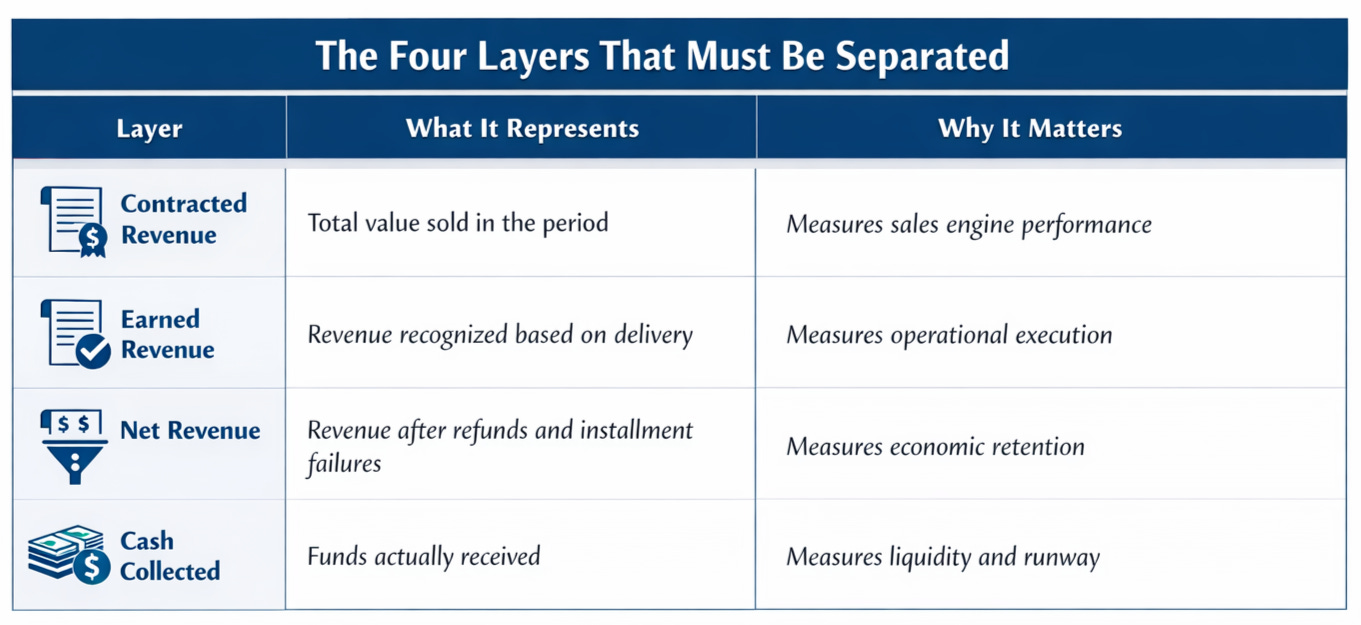
The four financial layers that must be separated: contracted, earned, net, and cash
Why matching ad spend to revenue (not cash) changes ROI decisions
How deposits and refunds create hidden risk
How cohort analysis reveals shifts in sales quality and retention
Why modified accrual offers a clearer operational lens than pure cash — and often more clarity than full GAAP
If your margins feel volatile, your performance feels inconsistent, or scaling decisions feel heavier than they should, this will explain why.
If Cash Collected Is Treated Like “Revenue”, Then Your Numbers Are Lying To You
Most high-ticket online companies don’t have a cash problem.
They have a measurement problem.
If your numbers feel inconsistent month to month — if margins swing unexpectedly, if ad spend decisions feel reactive, if profitability looks strong one month and compressed the next, if the story you know doesn’t line up with the numbers you see — the issue is often not performance.
It’s lens distortion.
High-ticket coaching companies are typically cash-heavy businesses. Gross margins appear high. Delivery costs are largely ad spend, labor and software. Payment processors clear funds relatively quickly. Enrollment spikes translate into visible bank balance growth.
And when cash is flowing, leadership feels secure.
But cash flow is not performance clarity.
Cash tells you whether you can operate.
But it’s revenue that tells you whether your model actually works.
And they’re not the same.
When those two are treated as interchangeable, strategic distortion begins. And the ability to scale is hindered.
Why Cash-Basis Works — Until It Doesn’t
In early-stage companies, cash-basis thinking is logical.
When survival is the primary objective, liquidity is the binding constraint. The dominant question is: “Do we have enough cash to keep going?” Or even, “Do we have enough cash to keep slapping onto ads & commissions so as to keep growing?”
Cash answers those directly.
In most industries, companies grow gradually, allowing financial systems to mature alongside revenue. But in high-ticket online models, growth often accelerates far faster than internal architecture evolves. Companies often move from zero to seven figures in 1 to 3 years..
Because of this speed, many companies remain on a cash or modified cash lens long after it stops being strategically sufficient.
For a time, it works.
Cash balances grow.
Margins appear strong.
Liquidity remains ample.
But once the objective shifts from survival to intelligent scaling, cash alone becomes inadequate. Way too many blind spots at stake.
Where Cash Distorts Reality
High-ticket programs operate on a contract-based structure.
Revenue is contracted upfront.
Cash is collected over time.
Delivery begins immediately.
These are three separate financial events. When they are collapsed into one metric — cash collected — visibility disappears.
Let’s walk through a simplified three-month example.
Coaching Program Example:
Scenario
In January, a high-ticket coaching company sells $1,000,000 in programs. Of those sales, 50% were PIFs, and the other 50% were PIPs (2-month-installments at 30% and 3-month-installments at 20%).
That makes cash collections to be as follows:
50% upfront in January
30% in February
20% in March
January
Contracted Revenue: $1,000,000
Cash Collected: $500,000
February
Cash Collected: $300,000
March
Cash Collected: $200,000
Now, let’s additionally assume the following for ad spend and delivery costs:
January ad spend: $250,000
January delivery & support costs: $200,000
And for contra-revenue, we can assume:
• 8% refund rate
• 5% installment failure on remaining balances
Layer 1: ROI Distortion
From a cash lens in January:
“Revenue”: $500,000
Ad spend: $250,000
So returns look like 2x.
But the sales engine actually generated $1,000,000 in contracts, not $500,000.
So, returns on contracted value were actually 4x.
Now, layer in refunds and failures, and net retained revenue becomes approximately $870,000.
Which lowers return slightly to 3.6x.
So you see, your true performance is neither $500,000 nor $1,000,000 in terms of sales
It’s $870,000.
Cash alone cannot show you that.
That difference between 2x and 3.6x materially changes scaling decisions.
Cash suggests caution.
Revenue suggests controlled acceleration.
Layer 2: Monthly Profitability Distortion
Now, let’s take it one step further to assess impact on profitability.
If January performance is evaluated on cash, here’s what things look like:
Revenue: $500,000
Ad spend: $250,000
Delivery: $200,000
“Profit” = $50,000
January appears barely profitable.
But economically:
Net retained revenue: ~$870,000
Less acquisition & delivery: $450,000
Contribution: ~$420,000
The business was strong — but cash timing hid it.
Because acquisition costs occur in Month 1 while collections continue into Months 2 and 3:
• January looks weak.
• February and March look inflated.
Profitability becomes a function of payment schedules rather than operating performance. And once that distortion feeds into hiring, ad scaling, or capital allocation — strategy begins drifting away from reality.
Remember this:
Cash measures liquidity.
Revenue measures performance.
Confuse the two, and you misread the business. And misguide it unknowingly.
When Cash Makes You Look More Profitable Than You Are
Those were the good scenarios, where cash under-estimates real performance. But beware, cash can just as easily hide growing tumors within.
Because the distortion works both ways.
In high-ticket coaching, cash can just as easily create a false sense of strength.
1. Refund Lag
A large launch collects $700,000 upfront on $1,000,000 in contracts.
Ad spend and delivery total $450,000.
On a cash basis, January looks highly profitable.
But if 10–12% refunds materialize over the next 60 days and installment failures rise, retained revenue compresses significantly. What looked like a 35% margin month may settle closer to 20% — or lower once fulfillment intensity increases.
Cash shows momentum.
But your revenue-adjusted performance might reveal thinner economics.
2. Deposit Illusion
Deposit-heavy models are particularly misleading when improperly structured.
If 100 customers place $2,000 deposits, that’s $200,000 in cash collected.
But deposits are liabilities, not earned revenue. If a meaningful percentage fail to convert or request refunds within policy windows, true retained revenue may fall well below what cash suggested.
If acquisition spend was incurred to generate those deposits, the month may have been break-even — or negative — despite strong collections.
Liquidity is not profitability.
3. Installment Decay Masked by New Sales
As long as new cohorts continue enrolling, total monthly cash collections can remain strong even while older cohorts deteriorate.
Refund rates creep up.
Installment failure increases.
Chargebacks rise.
Cash inflow appears stable because new sales offset decay. But revenue per cohort is weakening. Margin durability is eroding. Risk exposure is rising.
Cash reporting will not isolate that deterioration.
Cohort-level revenue analysis will.
4. Risk & Reserve Exposure
Processor thresholds are tied to dispute rates — not cash balances.
A spike in chargebacks can trigger rolling reserves or account monitoring, restricting access to capital even when the business appears profitable on paper. So you made sales, collect less cash on those sales due to reserves taken, and now have a much greater exposure to risk due to processor scrutiny.
And the risk exposure doesn’t simply extend to cash collected, but your total revenue now and in the future.
Cash measures liquidity.
Revenue intelligence measures durability and risk.
And in this industry, durability determines whether growth compounds — or collapses. When these layers are blended together, leadership optimizes against incomplete signals.
So Where Does This Really Break The Business?
1. Ad Spend Optimization
Proper expense analysis is revenue-dependent.
Marketing dollars are deployed to generate contracts — not cash. But when performance is measured against cash collected in the same month, timing distortions immediately enter the equation.
Cash collected in March may reflect contracts sold in January. Meanwhile, March’s ad spend may have generated contracts that won’t be fully collected until April or May.
If you evaluate marketing efficiency against cash instead of contracted revenue, you are no longer measuring the return on that month’s marketing input. You are measuring a blended lag effect from prior periods.
From a finance standpoint, this violates the matching principle — the foundational accounting concept that expenses must be evaluated in the same period as the revenue they helped generate.
When matching breaks, contribution margin analysis breaks.
Contribution margin should answer:
What did it cost us to generate this revenue?
What margin did we retain after direct acquisition and fulfillment costs?
How efficient is each sales channel or campaign?
But if revenue and expenses are misaligned by timing, your contribution margin fluctuates artificially. Some months appear highly efficient because cash from prior sales is flowing in. Other months look inefficient because installment-heavy sales haven’t yet translated into collections.
That distortion corrupts trend analysis.
And without clean trend analysis, you cannot:
Identify scaling thresholds
Diagnose declining channel efficiency
Optimize CAC relative to contract value
Make informed budget allocation decisions
In high-ticket coaching, where CAC can be material and margins appear strong, this misalignment is particularly dangerous. It creates false confidence or unnecessary contraction.
Scaling decisions become aggressive or conservative — but for the wrong reasons.
2. Margin Illusion
Cash-basis thinking introduces what I call margin illusion.
When collections are heavy in a given month due to prior installment inflows, profit appears inflated. But that cash may relate to revenue earned in prior periods.
Conversely, a strong sales month structured heavily on installments may appear weak under a cash lens because collections lag behind performance.
The result?
Leadership begins attributing performance to the wrong inputs.
You may believe:
“March was incredibly profitable — let’s double down.”
“April underperformed — we need to cut spend.”
“This campaign isn’t working.”
“Margins are compressing.”
When in reality, the only thing changing is timing.
In accrual-based revenue analysis, margin is evaluated against earned revenue — not cash movement. That allows you to properly analyze:
Gross margin by cohort
Contribution margin by campaign
Variable cost leverage
Trend stability across time periods
Without proper period matching, strategic conclusions about “what worked” become unreliable. You are optimizing against noise instead of signal.
And scaling against distorted margin signals compounds error. It doesn’t correct it.
You cannot refine strategy without accurate period matching.
3. Deposit and Refund Risk
Deposits introduce a second layer of distortion: liquidity without earned performance.
A deposit improves cash position immediately. But economically, it represents either:
A liability (if refundable or subject to dispute), or
Deferred revenue (if services have not yet been delivered)
If deposits are treated as performance instead of liability exposure, leadership overestimates stability.
This is particularly relevant in high-ticket coaching where:
Deposits may secure intent before full commitment
Refund windows may extend 7–30 days
Installment plans introduce payment decay risk
Chargebacks may arise months later
From a CFO perspective, revenue must be evaluated on a risk-adjusted basis.
That means understanding:
Refund rate by cohort
Chargeback incidence by sales channel
Installment default patterns
Time-to-collection decay curves
Cash does not quantify risk exposure. It reflects liquidity.
Revenue analysis — particularly net revenue after refunds and disputes — reflects performance durability.
If a company is booking strong cash inflows but refund behavior is trending upward or installment completion rates are declining, that is a leading indicator of future compression.
Under a cash-only lens, this risk remains invisible until liquidity tightens.
The Inflection Point
So it’s true — in high-ticket coaching, cash-basis thinking can sustain early growth, sometimes well into the low eight figures.
Early on:
Margins appear high
Overhead is relatively light
Growth is fast
Liquidity is strong
The distortion is present — but immaterial. No biggie.
But as you continue to grow, soon the weight will become too much. It’s like stacking textbooks on top of a tower of blocks. the first few will hold no problem. But keep stacking the weight, and it will topple.
Once you hit a few million, ideally the change toward revenue insights should be made. Though not to your benefit, you can theoretically hold off — as I’ve seen many clients do, since they’re so growth-focused.
But once you roughly hit between $10M and $25M, that distortion becomes material, and fundamental change is NO LONGER avoidable.
At this stage:
Marketing budgets increase materially.
Sales headcount increases.
Refund volume grows in absolute dollars.
Processor monitoring thresholds tighten.
Installment receivables compound.
Team expansion increases fixed cost exposure.
Timing differences that were once small, now meaningfully influence:
Hiring decisions
Compensation planning
Capital allocation
Cash runway forecasting
Risk tolerance thresholds
A $300K timing distortion at $3M revenue is survivable.
A $3M distortion at $20M revenue changes strategic posture.
Without separating:
Contracted revenue
Earned revenue
Collected cash
Refund-adjusted net revenue
Leadership loses visibility into true performance.
And once visibility erodes at scale, decision quality deteriorates. Not because the business is failing. But because the lens is misaligned.
The Power of Cohort Analysis
One of the most powerful shifts a high-ticket company can make is moving from period-based reporting alone to cohort-based analysis.
A cohort is simply a group of customers segmented by the month (or campaign window) in which they enrolled.
For example:
January Cohort: All customers who signed contracts in January
February Cohort: All customers who signed contracts in February
Instead of asking, “How did we perform in March?” cohort analysis asks:
“How is each enrollment group performing over time?”
Each cohort is tracked for:
Total contracted revenue
Revenue earned
Collection velocity (Month 1, 2, 3)
Refund and chargeback rates
Installment completion rates
Net retained revenue
Contribution margin
This changes the level of insight entirely.
Under a cash lens, performance is blended and time-shifted. February collections may reflect January sales. Refunds appear disconnected from their originating cohort. The signal gets diluted.
Cohort analysis isolates performance at the contract level.
If January refunds at 6% and February at 15%, something changed — targeting, messaging, fulfillment capacity, or sales quality. Cash reporting won’t clearly isolate that shift. Cohort analysis will.
From a CFO standpoint, this is revenue durability analysis.
It separates volume growth from quality growth — which are not the same.
A company can increase contracted revenue while quietly degrading installment completion or refund behavior. Cash may remain strong temporarily, but durability may already be weakening.
Cohort analysis makes deterioration visible before liquidity reflects it.
That is revenue intelligence.
The Four Layers Your Business Needs
These are the four layers you should be tracking. When they are separated, performance becomes measurable and controllable
The Required Shift
This does not require immediate migration to full GAAP ASC 606 for internal decision-making.
In fact, for most privately owned, founder-led high-ticket companies, blindly migrating to full U.S. GAAP (ASC 606) can reduce operational clarity.
Straight-line revenue recognition may satisfy compliance standards, but it often obscures sales attribution, cohort performance, and real-time revenue intelligence in contract-based, installment-driven models.
Unless the company is pursuing institutional capital, private equity, or a public transaction, full GAAP can introduce reporting distortion without adding strategic value. (I’ll unpack that in a future article.)
What is required, however, (and sooner than later) is a modified accrual framework — intentionally designed around how this industry actually sells, delivers, collects, and absorbs risk.
That means structurally separating:
Contracted revenue
Revenue earned
Net retained revenue
Installment receivables
Cash collected
This is not just an accounting preference. It’s structural design.
Most companies lack:
Order-level architecture linking contracts to invoices and payments
Clean tracking of installment receivables
Refund attribution by cohort
Risk-adjusted revenue visibility
Without this architecture, KPIs are partially constructed at best.
At minimum, leadership must clearly distinguish:
What was sold
What was earned
What was retained
What was collected
Only then can you accurately evaluate:
Campaign efficiency
Refund-adjusted margins
Installment durability
Cash conversion dynamics
True scalability
This is not cosmetic accounting refinement.
It is structural clarity.
And scaling without structural clarity amplifies distortion.
This Is Not an Accounting Debate. It’s a Capital Discipline Decision.
Cash keeps the lights on.
But liquidity alone does not validate a business model.
In high-ticket coaching, strong collections can mask weak retention, deteriorating cohort quality, rising refund exposure, or inefficient acquisition economics. When cash and revenue are conflated, leadership loses the ability to distinguish between survival and durability.
The result?
Margins appear volatile.
Performance feels inconsistent.
Risk builds beneath the surface.
Scaling decisions drift toward intuition instead of evidence.
Separating revenue from cash is not an accounting preference. It is the difference between managing liquidity and managing a business.
Revenue — properly structured, matched, and risk-adjusted — tells you whether your acquisition engine works, whether your cohorts hold, and whether your margins are resilient under pressure.
Cash answers, “Can we operate?”
Revenue intelligence answers, “Is this model scalable?”
If you intend to grow beyond early momentum — if you intend to allocate capital deliberately rather than reactively — this separation is non-negotiable.
In the next article, I’ll break down how installment plans create an additional layer of distortion — and why treating them like subscriptions compounds the problem.
Want to chat through how you can uplevel your revenue intelligence?
→ Get in touch here: letsdothis@businessbetterbuilt.com
To your success and scale,
— Ciára
Fractional CFO & Financial Growth Advisor
Founder, Business Better Built